Sunday, May 19, 2013

Interview with Author Linda Crotta Brennan


Once, In America... 

citizens were sickened by smog; pesticides wiped

out wildlife in towns, fields, and forests;

and the rivers were dirty enough to burn.


Author Linda Crotta Brennan’s newest title, WHEN RIVERS BURNED: THE EARTH DAY STORY, weaves together the environmental disasters experienced in America and the stories of the people who responded to them. It is a narrative timeline of the history of the creation of what has become a yearly global event Earth Day. The book, beautifully designed and illustrated by Lisa Greenleaf, promises to encourage another generation to care about our planet. WHEN RIVERS BURNED recently won an award from the Green Book Festival in the History category.
 
Welcome, Linda. Thank you for agreeing to be the first guest author on my blog.  I was intrigued by your presentation at the launch party. It was clear you’ve invested a good deal of time in writing this book. What is the most compelling part of the research process for you? What part of researching this particular book made your heart sing?

Primary research has to be the most exciting part of the research process. It was thrilling to hold documents written during the Revolutionary War when I was researching The Black Regiment of the American Revolution.

With When Rivers Burned, the research was more immediate. Since the first Earth Day took place after the invention of things like photography and television, I had the opportunity to watch video clips of the actual events and listen to speeches made by the participants. One chilling video will always remain in my mind, of kids being sprayed with DDT as they climbed aboard their school bus. It was also remarkable to hear the testimony of people who lived through the Donora, Pennsylvania smog disaster.

But the most exciting part of my research for When Rivers Burned was interviewing Denis Hayes, who ran the first Earth Day. He was incredibly generous with his time, answering my myriad questions at length and reviewing the manuscript for accuracy after it was completed.

Authors hear a lot about branding these days. With the exception of your picture books MARSHMALLOW KISSES and FLANNEL KISSES, a review of your book titles gives the impression that you gravitate to writing nonfiction about economics and history. You’ve also published a host of magazine articles about the natural world. In writing nonfiction, do you choose the topic or does the topic in some way choose you?

Sometimes I choose my topics, sometimes my topics are chosen for me, and sometimes projects are a bit of both.

I was commissioned to write the series of books on economics for third graders. I would never have chosen to write about that topic on my own. But despite my initial reluctance, I enjoyed learning about something totally foreign to me and figuring out how to present economics in a way that would be meaningful to children.

I chose the topics for all of my magazine articles on nature, from “Frogs on Ice” (Spider, Feb. 2013) which is about wood frog’s ability to survive being frozen, to slime mold (“The Blob From Inner Space,” Ranger Rick), one of my favorite topics. Did you know that slime mold reproduces like a fungus, but moves like an animal?

With When Rivers Burned, my publisher asked me to pitch something for her new series, Once in America, about pivotal moments in history. I came up with the first Earth Day as a topic from a broadcast I heard on NPR.

You have another newly published book – WOMEN OF THE OCEAN STATE: TWENTY-FIVE RHODE ISLAND WOMEN YOU SHOULD KNOW. You’re familiar with writing biography. You’ve also written the story of Rhode Island’s Black Regiment. How does writing the story of a movement differ from writing a biography?

In many ways, it’s easier to write a biography. A person’s life has a natural structure, they are born, grow up, strive to accomplish something, die, and their legacy lives on.

A movement is amorphous. The writer has to decide what to include and how to shape the material. What are the roots of the movement? Who and what brought it to fruition? What did it accomplish? Where is it headed?

We hear a lot about that elusive quality called voice. Do you think voice contributes to a work of nonfiction and how? Are there current nonfiction books about the environment that inspired you?

Voice is as important to nonfiction as it is to fiction. Kathleen Krull's voice is humorous and snappy. She writes a biography like she's dishing out the latest gossip. Steve Sheinkin wrote The Bomb like a spy thriller. I strive to write nonfiction with an action/adventure flavor.

As to books about the environment which have inspired me, there have been many, The Swampwalker's Journal, Sand County Almanac, In Search of the Golden Frog, and Broadsides from the Other Orders to name a few.

Linda, can you talk about your selection of disasters that led to the creation of Earth Day? There were many areas that experienced smog, water pollution and the health hazards of pesticide application. How did you decide to focus on the cities and rivers that serve as examples in your book?

One of my biggest challenges was deciding what to include and what to leave out. Since this book was intended for a young audience, grades 5 and up, I had limited space. While many cities suffered from smog, and other rivers burned, I chose to use the examples which kept coming up in my searches. These places had garnered lots of press and captured the collective imagination.

Some say the efforts individuals and governments are making to save our planet are not enough. Are you encouraged or do you feel the response is too little and too late? How do you hope When Rivers Burned will have an impact on these efforts?

With our current contentious political environment, I don't think the environment is getting the attention it deserves. The quality of our environment affects all of us, Republicans and Democrats alike. But we've grown complacent, and desensitized to doomsday prophecies. I hope my book will remind people of what is at stake, and how important it is to act.

What particular part of the environment would you invest personal time and energy to preserve? What part of our earth calls to you?

There’s a common saying, “Think globally, act locally.” I spend most of my energy caring for my beautiful home state, Rhode Island. My husband and I have volunteered in a number of ways over the years, from helping set up family nature programs at our local refuge, to participating in the annual butterfly count. I’m an avid supporter of Citizen Science programs, and participate in Cornell Ornithology Lab’s Project Feederwatch. Of course, we also contribute to global environmental organizations and try to do our part in recycling and conserving resources.

WHEN RIVERS BURNED is geared toward young readers who are old enough to grasp the role politics played and continues to play in working toward a cleaner environment. It’s also an informative read for adults seeking an overview of the history of Earth Day. Did you have an idea of the book’s possible crossover role as you wrote it?

I wasn't really thinking of When Rivers Burned as a crossover book while I worked on it. I wrote it for kids, age ten and up. But I also wrote it for me, and maybe that's why it works so well as a crossover title.

You’re a writing coach. How does your teaching/mentoring of other writers inform your own writing? Can you recommend any craft books for writers that you’ve found helpful or informative?

I've learned more from teaching than I can say. As a teacher, I'm constantly evaluating what works in a manuscript, what doesn't, and why. That has to have an impact on my writing.

As for books on the craft, I recommend Anatomy of Nonfiction by Margery Facklam and Peggy Thomas and Peter Jacobi’s Writing the Nonfiction Article.

Will you leave us with a hint of your next writing project? Can we look forward to another well-researched nonfiction title or something entirely different?

This August I have a book on the Gulf Oil Spill coming out and another on the Boston Tea Party.

As for my current projects, my daughter's best friend works for NOAA and is stationed at the South Pole for thirteen months. She's graciously allowing me to interview her via email while she's down there. I'd love to write about her experience. I'm also playing with a middle grade mystery.

Thank you so much, Linda, for thoughtfully sharing your responses. And congratulations on your award-winning new book. Perhaps your next book involves a penguin visit! Is there anything else you’d like to share today?

I began my writing journey thinking that I'd write fiction, but along the way, I've discovered a passion for nonfiction. I revel in the research, and in revealing a little-known story to the world.

And speaking of little-known stories, I can't wait to read your book, Feathers and Trumpets, about the influential woman from the Middle Ages, Hildegard of Bingen. Thank you so much for inviting me to be a guest on your blog!

Thursday, May 9, 2013

Award Winning Book Challenge


THE WIND IN THE WILLOWS
by Kenneth Grahame
Lewis Carroll Shelf Award 1958  

Annotated Edition, Seth Lerer, editor, 2009

The Wind in the Willows was first published in 1908. There have been over a hundred editions since, some with beloved illustrations. The lives of Ratty, Mole, Badger and the escapades of Toad enchanted young readers two decades before Pooh and his friends arrived and years before Brian Jacques Redwall series portrayed animals in a social environment.

The plot revolves around three friends who feel they must rescue the fourth friend from his tendency to pursue dangerous activities. Mole and Ratty are content to explore the river in Rat’s boat all summer long. Toad, on the other hand, must try every new transportation device that appears. His latest love for a horse-drawn caravan is quickly forgotten when a motor car roars by, and despite warnings from his friends, Toad must have a motor car. Practical and wise Badger leads the efforts to turn Toad into a sensible toad.

When Toad is sent to jail for stealing a car, he escapes in disguise, only to learn that his estate, Toad Hall, has been taken over by the stoats and weasels. Badger leads Ratty, Mole and Toad on a charge to regain Toad’s ancestral home.

The action is interspersed with long passages highlighting the natural life, as in this description of Ratty and Mole’s boat ride:

Leaving the main stream, they now passed into what seemed at first sight like a little land-locked lake. Green turf sloped down to either edge, brown, snaky tree-roots gleamed below the surface of the quiet water, while ahead of them the silvery shoulder and foamy tumble of a weir, arm-in-arm with a restless dripping mill-wheel, that held up in its turn a grey-gabled mill house, filled the air with the soothing murmur of sound, dull and smothery, yet with little clear voices speaking up cheerfully out of its intervals. It was so very beautiful that the Mole could only hold up both forepaws and gasp, ‘O my! O my! O my!

In this annotated edition, Seth Lerer defines words no longer used. Did you know that fusty connotated “moldy, old or passé qualities in people or things?” He locates The Wind in the Willows in Edwardian England and explains connections between society and the book. While Grahame gave the reader the setting, Lerer shows us the literature and the social framework that influenced Grahame.

For example, the Romantic vision of water, rivers and streams found in the poems of Shelley, Wordsworth and others is reflected in the riverbank setting where so much of the story takes place. Even Shakespearean influences are present. Pan’s music draws Rat and Mole as Ariel’s’ music calls to Ferdinand in The Tempest. Toad disguises himself as a washerwoman much like Falstaff dresses up as an old aunt in The Merry Wives of Windsor. Lerer points out that The Wind in the Willows’ readers were familiar with a work titled Three Men in a Boat. This novella told the adventures of three companions enjoying rowing on the Thames River, a pastime that was popular by the end of the 19th century. In addition, science and technology were changing the world at the dawn of the 20th century, so it is natural for aristocratic Toad to fall in love with motor cars. It’s fascinating to understand the many connections between Grahame’s work and the world he lived in.

This annotated edition has beautiful color plates with the artwork of Ernest Shepard, Arthur Rackham and Charles van Sandwyk, among others. The entire book adds so much to a reading or re-reading of The Wind in the Willows. To enjoy the artwork of the many Wind in the Willows illustrators, visit the Kenneth Grahame Society website.


Friday, April 19, 2013

Personal Narrative Poems on Poetry Friday


Thank you to Irene for gathering today's offerings at Live Your Poem. It’s been a shocking and grief-filled week with the tragedies of the Boston Marathon bombing and the explosion in West, Texas. It’s been a time to focus on family and all that’s important to me.

A hip injury has derailed my intentions to write a poem a day in April, but this week I started a project -  writing from old family photos. Here’s the latest draft of a poem about my grandfather.

Eugene Ernest Beane

When I Knew You

I never knew you
when your ankle high shoes
were the norm, not tony
like that scarf wound round your neck.
A tuft of wavy hair above shorn temples
crowns your head, a rooster’s comb
declaring lordship of the coop.
I didn’t know that dapper look
existed half way to the Canadian border
in 1920s Maine. 

You sit there, alone on the door stoop,
balancing a cigarette between two fingers.
A wedding ring says you’ve already married
my grandmother. Your face is a mirror image
of my father’s young face but his forehead
will not be creased by the loss
of a brother who lies under a cross
in Belleau, France, leaving that gold star legacy 
in the window behind you.

When I knew you
your eyes twinkled, your cheeks puffed
and the reeds of your harmonica vibrated
with strains of “Home on the Range.”
On Sunday visits, you said, “Well now”
and pulled your harmonica from your pocket.
We sang “Red River Valley” and “Red Wing”
and I clanged the cowbells lining the windowsills
in your kitchen that smelled like applesauce
and popcorn when I knew you
and we knew each other.

                                    ~Joyce Ray 2013

In the next draft I will practice poet and New England College professor Maura MacNeil’s advice on expanding personal narrative poems with invented memory. In a 2008 article for New Hampshire Writer, MacNeil suggested this method as a way to give a poem emotional intensity for the reader as well as the author.

Friday, March 29, 2013

BUILD A POEM


Happy Poetry Friday! Mary Lee is hosting over at A Year of Reading today. 


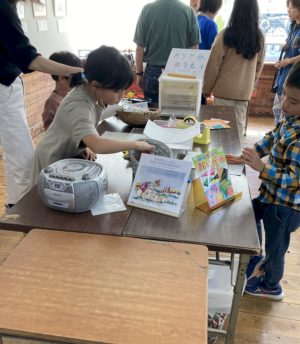
We got a head start on Poetry Month at our library with a three-session BUILD A POEM workshop in March. The children were so receptive and shared their deep wells of creativity. We probably didn’t change any lives, as Ms. Mirabel did in Word After Word After Word, but spending this time with six kids from my town was a gift to me. I encourage other poets to step out and share your love of writing poetry with kids. Here are some photos and samples poems generated by 4th and 5th graders. Our focus was strong verbs and words that feel good on your tongue.

We started with a mask poem, becoming the tree that was living before it became the wood we wrote on. 


William Carlos Williams’ poem “This is Just to Say” was our model for apology poems.

I’m sorry I ate the last                                  I’m sorry for stuffing you
piece of strawberry pie                                 in your cat carrier
which was probably for dessert,                   and leaving you for an hour.
but the crust was so flaky                             I’m sorry for forgetting you
and the inside so red                                      and for missing your dinner.
and juicy.
Please forgive me.


We experimented with the Six Room Poem exercise from Georgia Heard’s Awakening the Heart to write about a special place.


At each session, we wrote on wood and boxes and built a Poem Center for display. 


The culminating activity was a cupcake poem about spring!